
Guard patrol system

Guard patrol system for South African security companies.

A guard patrol system records whether security officers completed their rounds. In Shepherd, the officer taps an NFC tag at each checkpoint on a phone. The time and place are saved, even without signal. Supervisors can see missed points, and your client can log in to see the patrols and incidents on their site.

Register now

One short sign-up. We set it up with you and WhatsApp you.

01How it works

How a guard patrol works in Shepherd.

  1. 01

    Place the checkpoints

    Fix NFC tags at the gates, doors, perimeter points and other places that must be checked.

  2. 02

    Build the round

    Set the checkpoints for each site, so every officer knows the route.

  3. 03

    Tap on patrol

    The officer taps each tag with the phone. Shepherd saves the time and place.

  4. 04

    Review and report

    Supervisors see completed and missed points. Your client sees the record for their site.

02In the app

One phone for the whole round.

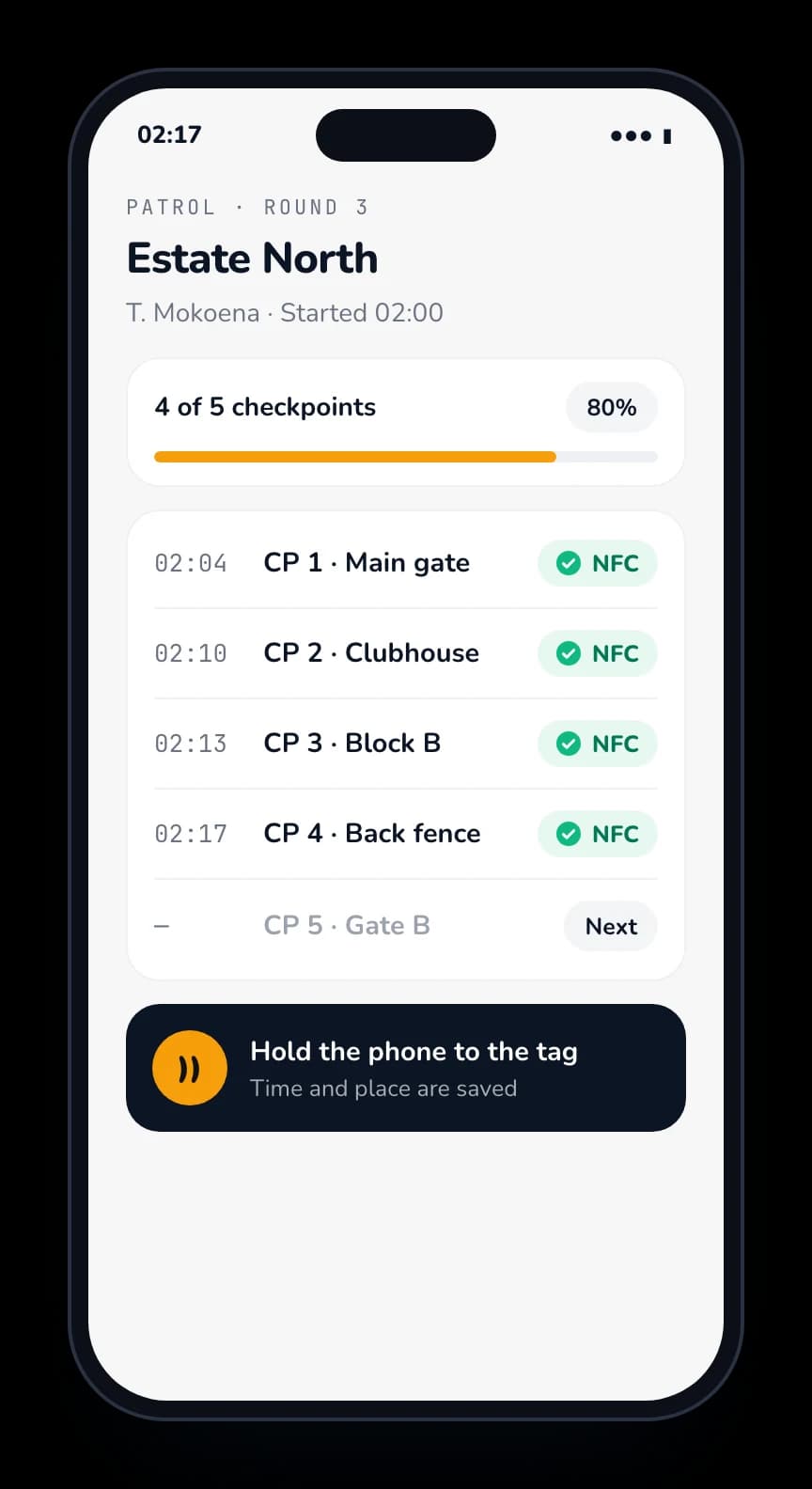
  • A patrol with NFC checkpoints ticked off with times.Paid extra

    Rounds with NFC tags

    Tap a tag at each point. The time and place are saved, not written down.

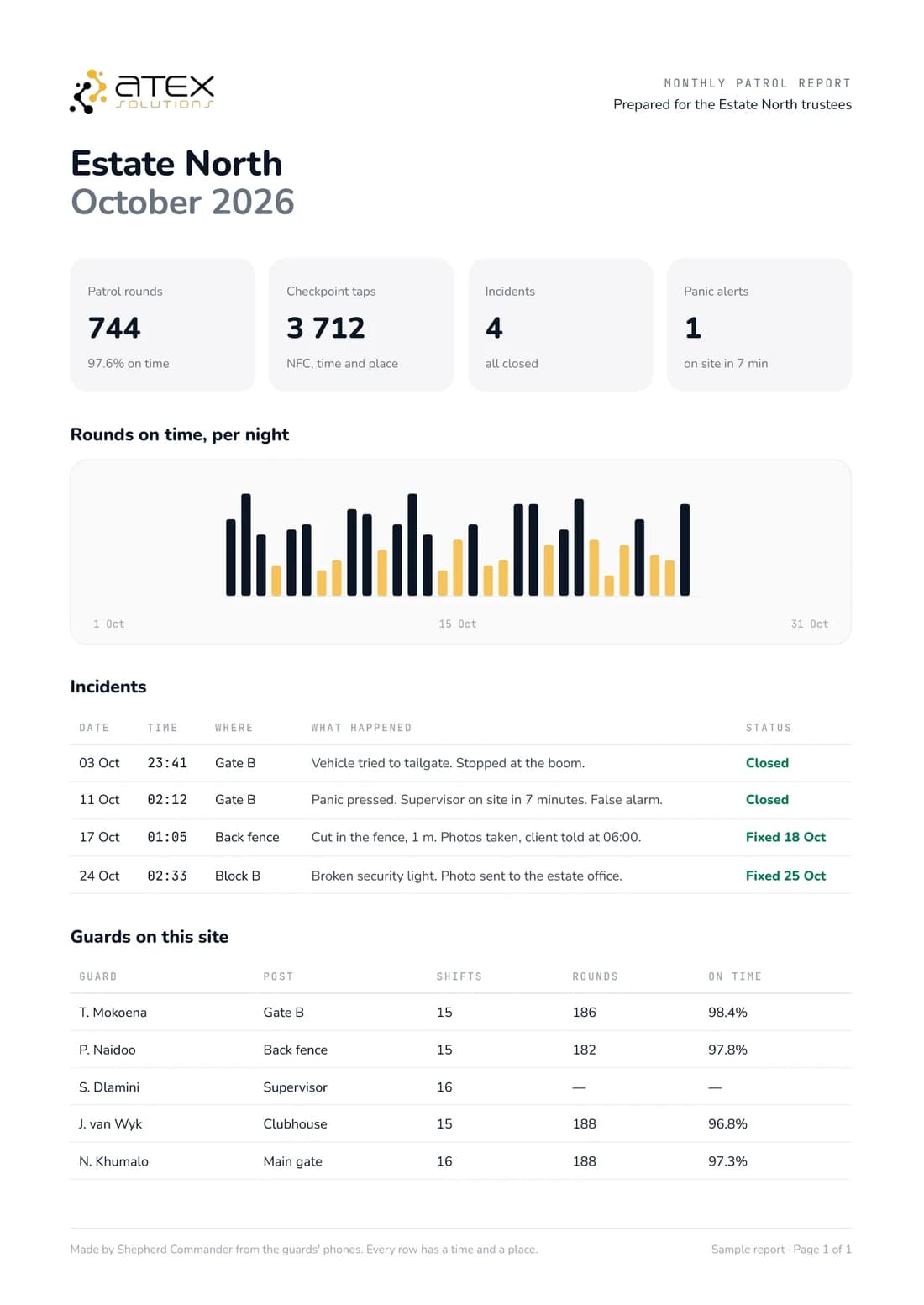
  • A one-page monthly report of the work done on a site.Paid extra

    Logins for your clients

    Your client logs in and sees the work done on their site, without phoning you.

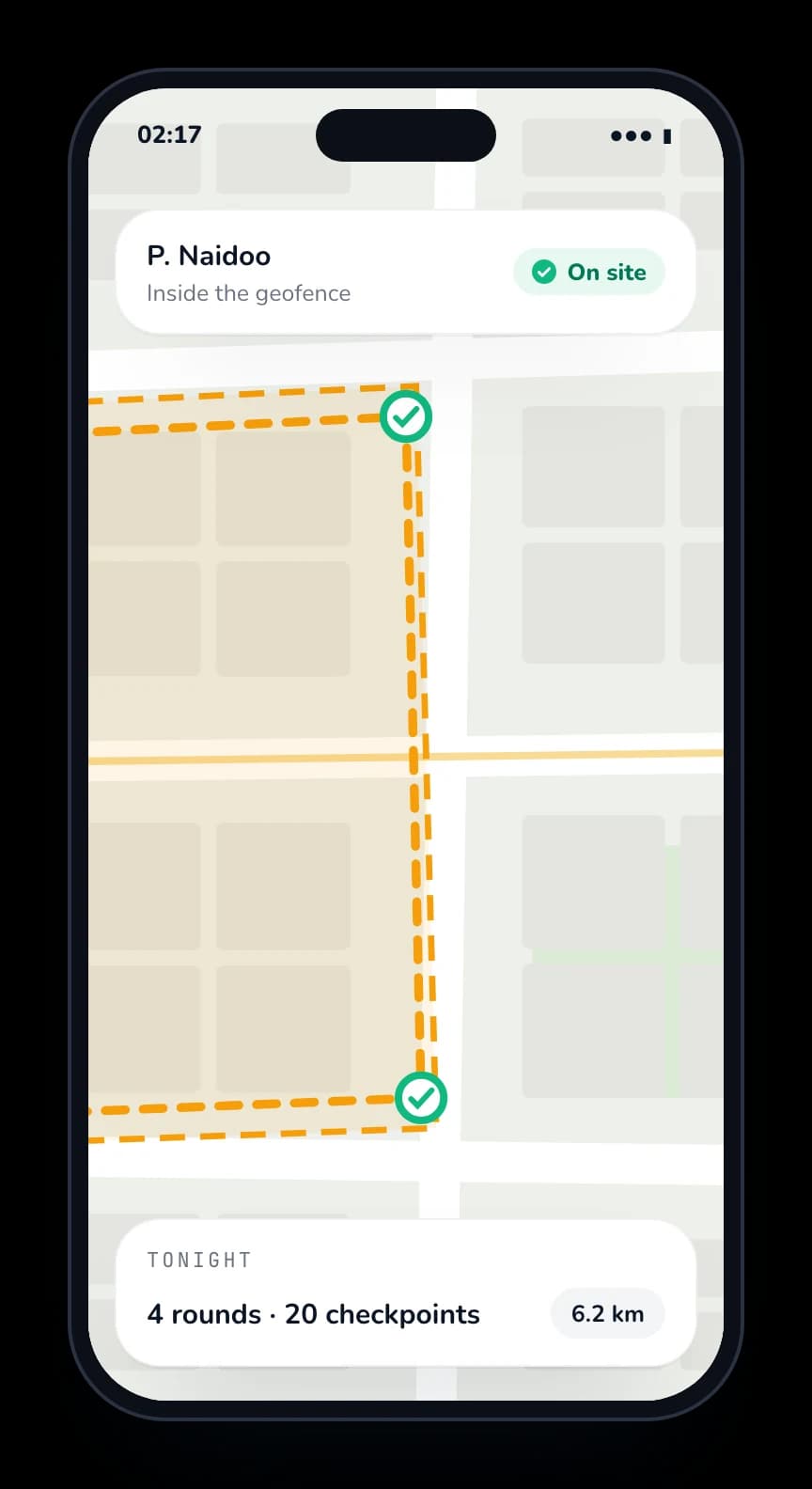
  • A live map with team members and a site fence.Paid extra

    Every site on one live map

    See your teams across all your sites, and know when someone leaves a site.

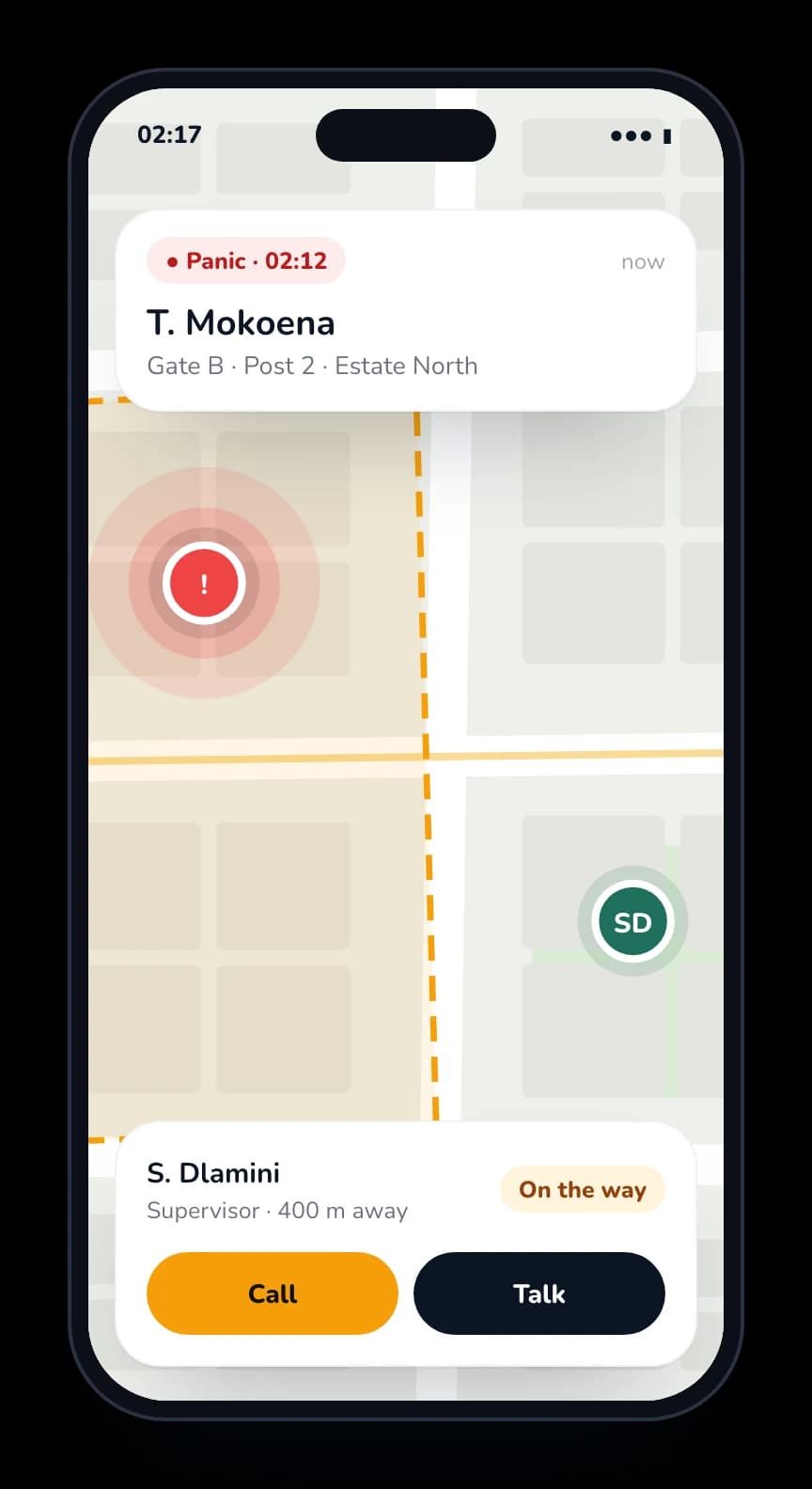
  • A panic alert with the person’s location on a map.Paid extra

    Panic and SOS

    One press, and the control room sees who and where.

03The detail

The basics

What is a guard patrol system?

A guard patrol system, also called a guard tour system, gives a security company a dependable record of its rounds. It replaces handwritten patrol sheets and reduces the work of collecting information from older clocking devices.

Most modern systems use checkpoints at fixed places on a site. An officer checks in at each point during the round, and the system stores when and where that happened. Managers then use the record to run the site and report to the client.

Shepherd adds that record to the daily work of a security operation. The same platform covers attendance, incidents, push-to-talk, live tracking, panic and SOS.

What it proves

What each check-in tells you.

A checkpoint tap tells you that the phone reached that tag at a specific time. It gives supervisors and clients a clear timeline for the round, without waiting for someone to retype a paper sheet.

It does not tell you everything about the quality of the inspection. Good patrol instructions still matter. If something needs attention, the officer can log an incident with photos, so the round includes what was found as well as where the officer went.

No signal

What happens with no signal or during load shedding?

Patrols keep working without mobile signal. Taps and incidents are saved on the phone and sent when it is back online, so a dead spot on the route does not break the round.

NFC tags do not need mains power or a battery of their own. During load shedding, the officer needs a charged phone to continue the patrol.

Missed points

How missed points are handled.

Missed checkpoints show up the same night, so a supervisor can follow up while the shift is still fresh. You do not need to wait for month-end paperwork to find a gap in a route.

This keeps the conversation practical. The officer, supervisor and control room can look at one record and deal with what happened on the site.

Your client

What your client sees.

Your client can have a login showing the patrols, checkpoints and incidents for their site, each with the time and place. Reports can also go out on their own, and the month can be summarised on one page for trustees or site managers.

That gives you a simple answer when a client asks what happened overnight. The evidence is already there.

What you need

What you need to get started.

You need checkpoint tags on site, a phone that can read them, and Shepherd set up for your sites and teams. Officers can use one rugged phone per post, locked down for work. It can also carry push-to-talk, live tracking, panic and SOS.

We can supply rugged phones and NFC checkpoint tags, and set them up with you. Shared devices at a post can use Shepherd Kiosk, where people sign in with their face and patrols can use NFC, QR or GPS check-ins.

Built here

Built, developed and supported in South Africa.

Shepherd is built by our own developers in South Africa, for South African security companies. It is not an imported system that you report a problem on and then wait months to hear back.

When something needs fixing or your operation needs a change, you speak to the team that builds and supports it. Feedback from security companies goes straight to the people who write the software, and we set up devices and sites with you here.

Cost

What does a guard patrol system cost?

Clock-in and time and attendance are free to start. Patrols are a paid feature, and you see the price when you register, before you commit to it. Your total also depends on whether you need tags, phones or other hardware.

Compliance

PSIRA and POPIA: where patrol records help.

Patrol records can support your operational files by showing what was done, where and when. They do not replace your PSIRA registration, your legal duties as an employer, or advice about your own compliance position.

Patrol data can include information about people, so decide who needs access and explain how it is used. We follow POPIA, and we never sell your data.

04Compare

Paper, wand or live phone system?

Paper sheetOffline wandShepherd on a phone
Check-inWritten by handTouched to a pointNFC tap on the phone
When you see itAfter collectionAfter the wand is downloadedAs it syncs, including after offline rounds
Client accessCopies or scansExported reportsClient login and reports
Incident photosSeparate processSeparate processLogged from the phone
Calling for helpSeparate deviceSeparate devicePanic and SOS on the phone

05Getting started

Start with the basics. Add what you need.

Clock-in and time and attendance are free to start for your whole team, with no card and no contract. Paid features are priced when you register, and only if you pick them.

Register now

One short sign-up. We set it up with you and WhatsApp you.

Free to start
  • Clock in on their own phone
  • GPS check: only at the site
  • Face check, so nobody clocks in for a friend
  • See who is at work right now
  • Timesheets
  • Leave requests
  • Staff documents
When you need more
  • Push-to-talk on the phone
  • Patrols with NFC checkpoints
  • Live tracking and geofences
  • Panic and SOS
  • Training courses
  • Payroll export (Sage, PaySpace, Xero)
  • Shift planning
  • Many sites on one live map
  • Logins for your clients

06Questions

Guard patrol questions.

What is the difference between a guard patrol system and a guard tour system?

In practice, buyers use the terms for the same thing: a way to record that officers visited set checkpoints on a round.

Is the software built in South Africa?

Yes. Shepherd is built, developed and supported by our own team in South Africa, so feedback and changes go straight to the people who build it.

Does Atex provide security guards?

No. Atex provides the software, devices and support that security companies use to run and prove their patrols.

Does the guard patrol system work offline?

Yes. Taps and incidents are saved on the phone and sent when it is back online.

Can my client see the patrols?

Yes. Your client can have a login and reports showing patrols, checkpoints and incidents on their site.

Can we use QR codes or GPS instead of NFC?

Shepherd Kiosk supports NFC, QR and GPS check-ins for patrols.

Can it work with our other systems?

We connect Shepherd to access control, CCTV, payroll and other systems as part of a custom solution.